Read more about the incentive and start your application.
Estonia has the OECD’s best tax system for the 12th year running, a top position in the Doing Business ranking, and has set in motion its first-ever large-scale investor incentive, designed to attract even more value-add projects to the country.
In September, the Estonian government unveiled the recipients of the country’s largest-ever investment support scheme. Three major projects with a combined value of nearly €400M will receive €44M in state support, aimed at developing hydrogen technology, gas power generation, and paper manufacturing.
“Never before in Estonia has such a large volume of investments been announced simultaneously, with this level of state financial support,” said Minister of Economy and Industry Erkki Keldo at a press conference. “This is a very important boost to Estonia’s economy and its competitiveness.”
The support scheme, launched in March 2025, is designed to help Estonia compete with other nations for large-scale investments. According to Keldo, other countries already offer similar flexible financial incentives to attract major investors, and Estonia needed to fill this gap in its value proposition. Here are the first announced winners.
BHG-Estonia — green hydrogen and ammonia complex in Sillamäe
- Total investment: €153.5M
- State support: €20M
- Jobs created: At least 32 high-paying positions
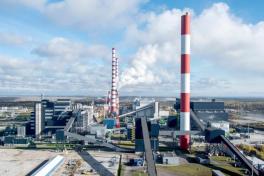
The project will establish Estonia’s first large-scale green hydrogen and ammonia production and infrastructure complex, including a hydrogen refuelling station for heavy machinery, storage facilities, 15 MW electrolysis capacity, and ammonia synthesis capabilities. It will reduce dependence on imported fossil fuels while supporting climate goals and energy security.

Sillamäe
Derivaat NH3 Power — gas power plant in Paldiski
- Total investment: €110.5M
- State support: €11M
- Jobs created: At least 30 positions
A 99 MW gas power plant will be built at Paldiski South Port industrial park. The facility, based on internal combustion engines, will help ensure Estonia’s energy supply security and provide necessary electricity to local businesses. Crucially, the flexible gas power plant can quickly respond to fluctuations in consumption and renewable energy production from wind and solar sources, making it essential for integrating more renewable energy into the grid.

Preliminary renderings of Derivaat NH3 Power plant
Horizon Paper and Cellulose — new production unit
- Total investment: €129.5M
- State support: €12.95M
- Jobs created: At least 30 direct positions
The company will establish a new production unit using innovative technology for manufacturing speciality kraft paper products. This project will help add value to local wood pulp and increase Estonia’s export value, building upon an already impressive timber sector. Previously, Horizon has been running a factory in Kehra for over 30 years, building a brand and impressive logistical operations. “Estonia is uniquely positioned as a gateway to Europe and the rest of the world. Well-connected by road, ocean transport, and rail to move goods across continents. Operating from Estonia, Horizon exports to over 70 countries with ease,” said Bashyam Krishnan, CEO of Horizon Pulp & Paper, to Invest Estonia.
How the support scheme works
The large-scale investment support scheme was created for 2025-2028 with a total budget of €160 million. Following recent budget negotiations, the government has agreed to extend the measure beyond 2028 with €40 million annually.
Key requirements for eligibility:
- Minimum investment of €100M
- Creation of at least 30 new jobs paying sector-average or higher salaries
- Maximum support rate of 10% in Harju County, up to 15% outside
- Maximum support amount of €20M per project
- Companies must have less than 49% public sector ownership
“Enterprise Estonia received three exceptionally strong applications that met all the criteria, so all three received positive decisions,” said Joonas Vänto, head of Invest Estonia. “We have provided preliminary consulting to about ten companies considering investments of this scale in Estonia, but not all are yet at the stage where they can apply for support.”

According to Minister Keldo, this is a support measure where the state can only win. Through taxes, job creation, and industrial growth, Estonia can “invest its way out of economic downturn.” The risks for the state are very low, as payments are made only after investments are completed. By the time support is paid out, the state budget will likely have already received at least an equivalent amount in tax revenue.
The support scheme addresses the intense competition between countries for business investments. “Countries are essentially buying large-scale, knowledge-intensive business investments from each other,” Keldo explained, noting that this is particularly true in Estonia’s region, where countries have similar conditions regarding location, resources, and labour availability.
The scheme moved rapidly from conception to implementation: the government approved it in September 2024, and the application round opened in early March 2025. The earliest payments are expected in 2026.
Applications are set to reopen on November 10th, with preliminary consultation already available. Read more and get in touch here.